

Think Small
“Think small” isn’t the sort of advice that is well-accepted by anyone with ambitious goals... But it should be.

“Think small” isn’t the sort of advice that is generally well-accepted by businesses, organizations or individuals with grand plans for the future. However, it is the sort of mindset that is inherently needed to achieve great things.
It’s also something that has been on my mind recently as I work to attract new clients, search for new opportunities and progress through a handful of side projects for myself. When we embark on such endeavors, all too often it’s tempting to fall into the trap of obsessing over the “big picture” instead of focusing on the minutia that’s actually most likely to make a significant difference in our lives.
When writing a novel, for example, the overall plot and broad themes are obviously an important component to successfully putting something engaging on paper. However, the key to actually alchemizing an idea into a fully formed 80,000-word narrative requires focus on something far smaller, detailed and ostensibly less grand: Writing the next line of dialogue, the next scene transition or even just the next sentence.
In other words, no matter how large your ambitions might be, it’s the small things that require your attention to successfully move from one point to another.
And to a large extent, despite how bullish I am about Artificial Intelligence in general, there’s a real danger that far too many people will use such tech to escape the monotony of obsessing over all those little things.
Just recently, for example, I received a mass-email from a former client that was unquestionably written by AI — or at the very least, it relied heavily upon such technology for its structure and content.
Now, I don’t begrudge anyone for leaning on AI to help create their communication content in today’s modern age — especially when financial realities tend to exclude the option of using high-priced copywriters, graphic designers or marketers in every application. However, such dependency on automation shouldn’t be blatant, nor should it be so extensive as to subvert one’s ability to finetune the details.
This is especially true for content that is supposedly designed to engage with an audience on a personal level. After all, if your target audience recognizes the signature of AI in your communications efforts, your entire relationship with them will suffer because no one likes to think there’s being “sold to” by a chatbot.
For an audience, realizing that AI has been instrumental in a brand’s outreach efforts is like trying to call a customer service number and having to navigate through an impersonal and complex automated message system — it feels disengaged and sterile to the point where the lack of personal attention being paid by the company is actually downright insulting.
Frustratingly, what makes it feel so insulting to the consumer is likely the exact same thing that makes it appear so attractive to the businesses themselves: The ease of AI promises to erase the arduous process of building an outreach campaign from the ground up. It (supposedly) allows the company to skip the details while implementing a “big picture” comms strategy.
Rather than agonizing over what words to choose, what tone to take or what rhythm sounds “natural” — you know, what we used to call “writing” — an organization can instead plug a prompt into ChatGPT and, seconds later, have a beautiful piece of copy written for them that uses all the “best practices” and proven techniques associated with mass communication.
Certainly, that seems appealing.
However, because AI defaults to “best practices,” it tends to produce content that looks, sounds and feels virtually indistinguishable from the sort of content already flooding our inboxes, social media timelines and (increasingly) the airwaves. (A problem that will only get worse as AI ads proliferate.) The result is content that looks as if it was mass-produced from a template — because, in a very real sense, it was.
“Boilerplate” content is, of course, nothing new. Such drudgery has long proliferated in the corporate world.
In the late 50s and early 60s, for example, Mad Men in glitzy New York advertising firms were so convinced they had developed an effortless formula for selling Detroit’s newest automobiles to a still booming American public, adverts for different manufactures began to look indistinguishable from one another.
Virtually every automobile ad adhered to a specific style — a format so ubiquitous throughout the industry, it was known as “the Ogilvy layout,” regardless of what firm actually put the campaign together. Want to sell a car? Slap together a picture of a beautiful vehicle in vivid color, along with two happy parents and their 3.5 darling children, and garnish the image with a couple columns of flowing text:
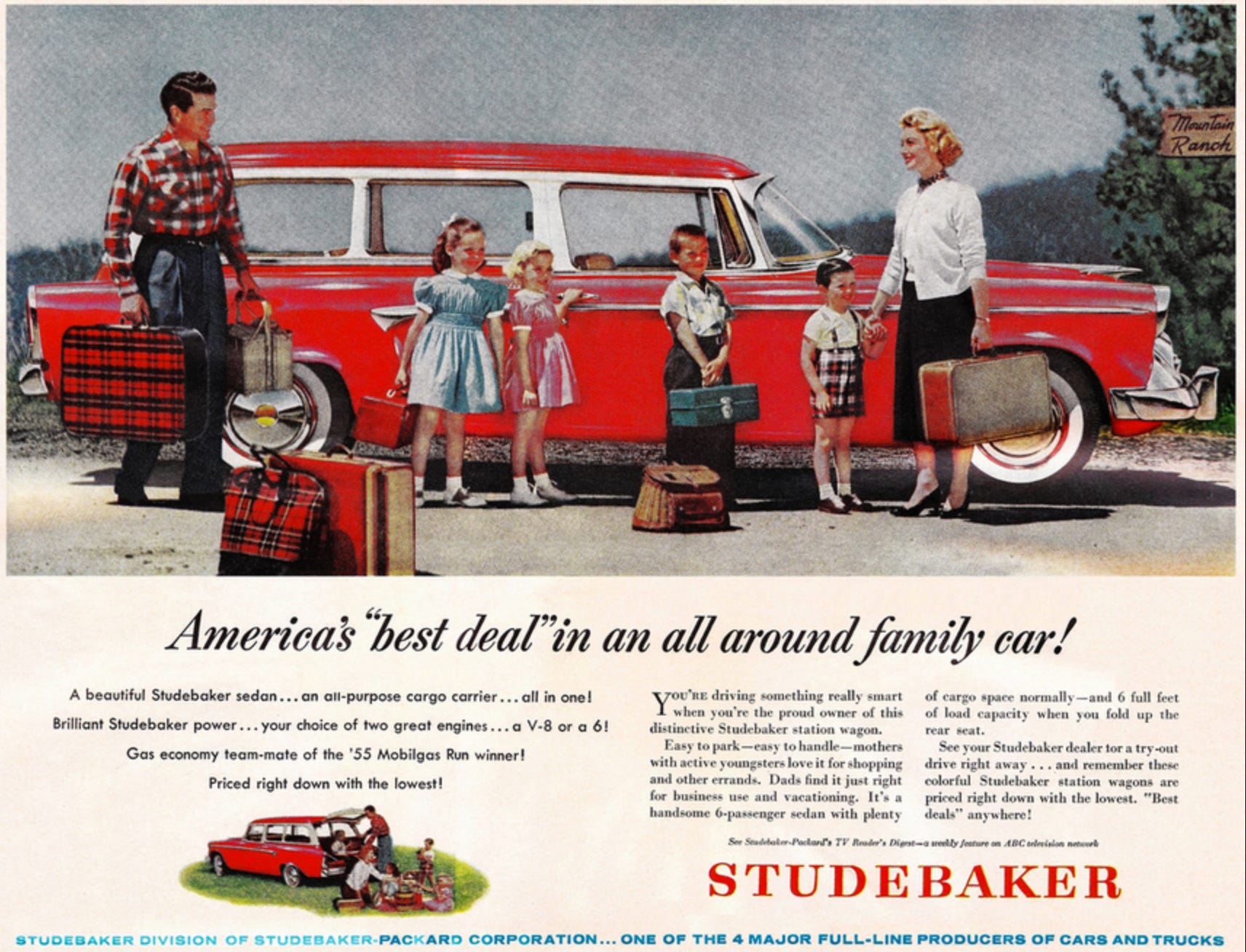
Of course, variations on this formula existed — but the structure, style and creative vision was the same at virtually every major advertising agency for such products. And (at least initially) it worked, so everyone in those Madison Avenue skyscrapers kept reaching for the same layout, the same colors and the same themes, regardless of what car they were trying to sell.
For one little German automobile manufacturer, however, this format simply wasn’t going to cut it.
When Volkswagen decided to break into the American market, it knew it was going to be a slog. For starters, the company had been founded by a certain nationalist wing of German socialists in the 1930’s at the behest of a failed painter with a funny mustache (which wasn’t great for their reputation in post-war America). Even worse, however, is that the company’s flagship vehicle was a slow, miniature and decidedly “cheap” alternative to the luxurious automotive masterpieces being pumped out regularly by Detroit.
On top of all of that, Volkswagen had virtually no budget for a serious advertising push into the American market. In 1950, Chevrolet had rocked the ad world by committing more than $50 million towards its marketing budget — and by 1959, the rest of Detroit was trying to catch up with ever-larger ad buys to produce evermore of their boilerplate salespitches.
Volkswagen, by contrast, wasn’t willing to spend even a fraction of that amount. Their 1959 campaign budget topped out at a paltry $600,000.
Ironically, many of the limitations set by the meager budget actually contributed to the success of what was eventually produced by one of Madison Avenue’s greatest ad men:
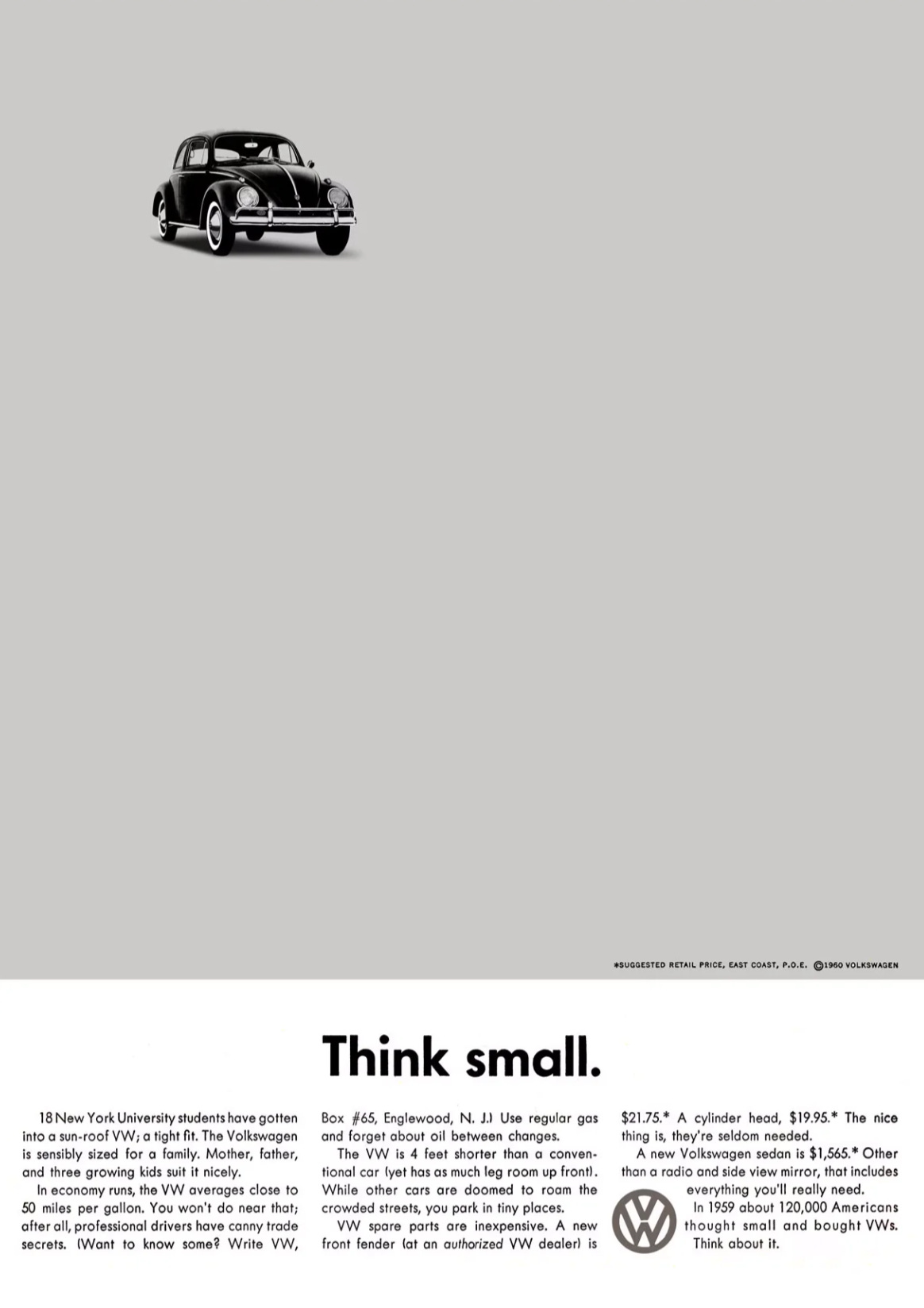
Bill Bernbach, the man who was in charge of the firm responsible for the groundbreaking “Think Small” ad campaign, knew what Volkswagen really needed was something distinct — not expensive or emulative of what everyone else was doing.
So, instead of bright colors, it was printed in black and white. Instead of romantic Americana scenery, it was given a stark white background. Instead of some glitzy logo plastered conspicuously across the page, there was an unobtrusive “VW” emblem placed awkwardly amidst the lower text.
And most notably, was the copy: Two words that were anathema to the mid-century auto industry, “Think small.”
The advert worked. Sales in the U.S. increased by more than 420 percent over the course of the next decade as “The Beetle” ensconced itself into American culture. And what made it work was its honest approach to selling itself to an admittedly niche portion of the American market. It was self-deprecating, refreshingly to-the-point and starkly divergent from anything other agencies were trying.
It was also an advert that almost didn’t get made.
When VW began shopping around for an agency, most of what was pitched their way were the usual variations of Detroit-style artwork. Agency after agency pitched what was essentially a template ad campaign, where a VW Beetle replaced what otherwise could have been a Studebaker, Ford or Chrysler.
But when VW spoke with DDB, it received something different. Bernbach’s pitch didn’t involve any visuals, mock artwork or flowing copy. Instead, he merely asked questions of the company, then explained he would have to “get to know” the product better before he could provide them with a solid idea.
And that’s what it took for VW know he was their guy. He made it personal and wasn’t afraid of tackling the nitty-gritty work of assembling a fresh idea from scratch, one piece at a time, rather than reaching for the nearest shortcut.
Indeed, most great ads seem to come from a similar dedication to building an idea from the ground up. For a perfect example, just look at Apple’s “think different” campaign from the late 90s:
What was “small thinking” about Apple’s campaign in 1997? Well, compare it to a typical Dell advert from the same time period:
Most computer companies were focused on promoting every technical specification of their product (whilst using the totally rad trend of rollerblading to spice things up, apparently). Apple, on the other hand, focused on a singular emotive reason for buying their product: They were different.
Apple didn’t need to tell you about RAM, CDROM capabilities or what graphic card was used, because the company wasn’t interested in competing with anyone on those terms. So, when it came time to craft a new image and rebuild the brand after years of struggling, it quickly realized it’s actual value wasn’t to be found in any of those performance specs — it’s value was something far more emotional, narrative and intangible.
And so, just like Volkswagen’s groundbreaking ad, Apple decided to slog their way through every little detail of building a new campaign structure from the ground up, producing an advert radically different from anything else flooding the airwaves.
In other words, it was a refusal to default to “best practices” and, instead, work diligently through every step of the creative process that ultimately produced such a powerful, effective and engaging work of public communication.
Worryingly, it’s that forced march through the “small things” that a dependency on AI-generated content risks forfeiting for those who use it too prolifically.
In the same way depending on boilerplate templates rob us of the steps necessary to stumble across new ideas, so too will an unhealthy reliance on AI for “content” generation. After all, those mundane details, all the little challenges that we are tempted to shortcut out of the creative process, are where the real opportunities often lie for innovation and originality.
So, whether you’re writing a novel, putting together an email campaign or simply jotting down some ad copy for social media, take a note from that plucky little German automaker with an unsavory origin story, and “Think Small.”
Especially when you’re trying to accomplish something big.
Michael Schaus is the founder of Schaus Creative LLC — a creative studio dedicated to helping organizations, businesses and activists tell their story and motivate change.